iOS
HamLog
Quick logging plus band plans, grid/bearing tools, wavelength calculations, WWV propagation information, DX cluster/spotting, DTMF, UTC and callsign lookup. This is field infrastructure, not a novelty logger.
HamLogApple App StoreRigs · antennas · power · programming · digital systems · emergency communications
Start with the equipment, then the antenna, then power and software, then the network. The internet has successfully hidden simple radio tasks across six vendor sites, three wikis and a forum thread from 2012. This page keeps the list focused on resources that are still useful.
Start with the layer that can actually be broken before blaming the layer with the fanciest acronym.
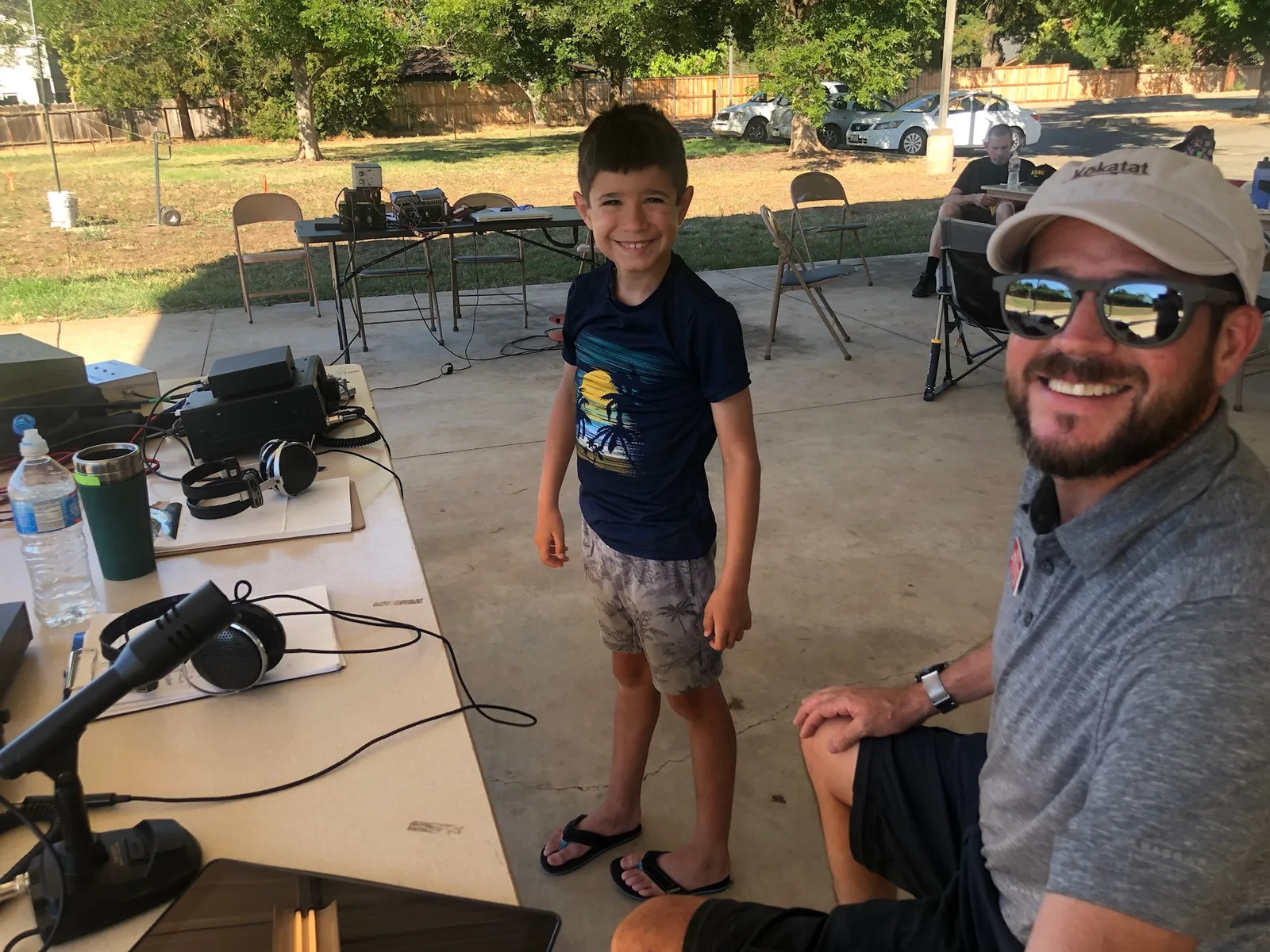
GEARS Field Day · Chico · 2022
Randall Stone and Karden Stone at the operating table. Manuals and directories matter most when they get the station on the air.
Field software that earns the battery
The useful apps answer a field question quickly: where is the repeater, what is the band doing, what room is active, what is my grid, what did I just work, and can this path reach licensed RF?
iOS
Quick logging plus band plans, grid/bearing tools, wavelength calculations, WWV propagation information, DX cluster/spotting, DTMF, UTC and callsign lookup. This is field infrastructure, not a novelty logger.
HamLogApple App StoreiOS · offline capable
Nearby amateur repeater discovery with a database that can be downloaded for offline use. Particularly useful after the phone loses the network that was supposed to tell it where the radio network is.
RepeaterBookApple App StoreiOS
GMRS repeater and callsign directory. Use for licensed GMRS route/destination discovery; repeater-owner permission and current status remain controlling.
myGMRSApple App StoreiOS · locator
Refresh the active-node database from Yaesu with Update Database, find a nearby WIRES-X node, then make the actual connection over RF with the FT-5DR. The phone finds the first hop; the radio makes it.
RF-on-the-fly procedureFT-5DR field stepsiOS · M17
Current M17 reflector client for receive/transmit, station activity, mapping, contact notes and supported RF interfacing. It is much more than the old “decoder” shorthand suggested.
MSeven - M17Apple App StoreBrowser · DMR
Receive-only live BrandMeister talkgroup audio/activity for discovery, net monitoring and diagnostics.
HoseLineLive BrandMeister audioWindows now · iOS forthcoming
One software client for AllStarLink, EchoLink, IAX Direct, DMR, System Fusion/YSF and M17. Office QSO One is not counted as operational under the present security settings; iOS is still forthcoming.
QSO OneCurrent platform and network statusiOS
Native phone access now. If the selected EchoLink endpoint is attached to an amateur repeater, the remote end can be RF even though the phone-to-node segment is Internet.
EchoLinkApple App StoreWeb
Live cross-network net directory covering AllStarLink, EchoLink, DMR, System Fusion, M17 and D-STAR. Useful as discovery; operator/network sources still control the final schedule.
Net FinderBrowse current listings1 · widest range / highest power first
Sorted roughly by operating range and practical transmitter class, rather than by which logo won the alphabet.
Yaesu
All-mode HF through UHF station/portable rig; external 13.8 V operation reaches the listed full-power levels.
Yaesu
Compact all-mode HF through UHF inventory rig.
Icom
Primary HF station transceiver; Icom retains the PDF behind its download terms.
Kenwood
The old dual-bander that still does several APRS tricks newer radios managed to misplace.
Yaesu
Legacy 2-meter rig retained in the equipment/manual archive. Third-party archival link is labeled as such rather than dressed up as a current Yaesu page.
Yaesu
Portable/field radio. Public station text deliberately does not imply that the radio, APRS beacon, and operator are inseparable.
BTECH
Useful field/programming reference for the tri-band handheld layer.
2 · RF leaves the radio here
Arrow Antennas
Roof-mounted dual-band antenna used as an external VHF/UHF feed; also useful as a portable design reference.
Station antenna
Two-element directional beam for 20, 15, and 10 meters, used in the IC-756 Pro III switched-feed arrangement.
Station antenna
The loop is the most-used HF antenna. The 40 m dipole is normally part of the switch matrix but is currently down for replacement.
3 · power
Owned generator
Core planning numbers: 120 V; 2,200 W max / 1,800 W rated; 18.3 A max / 15 A rated; 0.95 gal tank; about 3.2 hr at rated load or 8.1 hr at 1/4 load; 48–57 dB(A); 47.4 lb dry. Use the serial-number-matched Honda manual for maintenance and operating procedure.
Honda
The generator is an outdoor power source. Carbon-monoxide separation, fuel handling, ventilation, load limits, maintenance, and the exact serial-range manual control the field procedure.
4 · programming and backups
Read the radio first. Save the known-good file. Then make changes. Radios are remarkably good at remembering the one accidental checkbox you hoped they would forget.
RT Systems
Preferred workflow: read/backup the radio first, preserve the known-good image, then edit.
Yaesu
OEM route for cloning/programming and current firmware/manual revisions.
Open source
Use current CHIRP-next for supported radios; keep original images/backups before experimenting.
5 · digital systems
The new Digital Systems Field Guide separates air interfaces, IDs, hotspot/repeater settings, network destinations, and test methods. DMR, C4FM/WIRES-X, D-STAR, NXDN, P25, M17, AllStar and EchoLink each get their own page.
K6RCS
The missing layer: how the pieces fit together, not another link dump.
SharkRF
No device UID, passwords, API keys or local addresses are published.
QSO One
Useful precisely because it makes the network layers visible without requiring another physical radio for each one.
License practice
The current Technician, General and Amateur Extra pools are loaded into a browser-based K6RCS practice engine with official diagram support, full practice exams, subelement drills and local missed-question review.
Licensing · technical learning · adaptive retrieval
This began as Stone family dinner trivia and immediately exposed a much larger use. The same loop can drill an amateur-radio examination class, Part 97, band privileges, electronics, propagation, antennas, digital modes, emergency communications—or essentially anything else that can be learned through questions and explanations.
The useful discovery was not that machinery can generate a stack of questions. A static stack already exists. The useful discovery was a live drill that can respond to the learner while the learner is using it.
1 · ground the material
For licensing, use the current official examination pool and current FCC rules as the controlling material. Generated questions and explanations can support study; they do not replace the source or get to invent operating privileges.
2 · require retrieval
Ask one four-choice question at a time. The learner answers before seeing the result. Immediate retrieval is more useful than rereading a page until every sentence merely looks familiar.
3 · explain the distractors
Reveal the correct answer, explain why it is correct and explain why each other choice is wrong. A missed answer should identify the broken concept instead of adding another red mark.
4 · adapt in real time
Track misses and hesitation; revisit weak topics from another angle; change the mix and difficulty as understanding improves; avoid repeating mastered material merely because it is easy to generate. That is the personal part. The drill changes while the learner is still in it.
Use the current official amateur-radio examination pool and FCC rules as the controlling sources. Quiz me one question at a time with four choices. Wait for my committed answer before revealing the result. Explain why the correct choice is right and why every other choice is wrong. Track the concepts I miss or answer hesitantly; adapt the next questions in real time; revisit weak concepts from different angles; increase difficulty as I improve; avoid repeating mastered questions until the relevant pool is exhausted. Flag uncertainty instead of inventing a rule, privilege, frequency or examination answer.
The K6RCS licensing tools are paired with free amateur-radio instruction from ARRL instructor Randall Stone. There is no teaching fee; if in-person help requires travel, actual travel or transportation costs may be reimbursed.
6 · incident structure and public service
FEMA EMI
Incident structure is far more useful when learned before everyone is standing in a parking lot inventing job titles.
FEMA EMI
CERT roles, ICS integration, team structure and current resource-typing references.
ARRL
Amateur-radio public-service layer; NIMS/CERT links sit beside it so radio does not become the entire incident plan.
FCC
When an internet argument and Part 97 disagree, the internet does not get a vote.
7 · propagation, terrain and field conditions
Station engineering
Measured 2.4-inch and 4-inch Fair-Rite #31 winding choices, multi-band combinations, line properties, placement and thermal guidance.
Propagation
Useful live guidance; propagation remains stubbornly free to ignore the forecast.
Terrain
Terrain, ridges, passes and drainage tend to matter more than the repeater-directory optimism suggests.
Messaging
Packet and messaging references remain first-class tools rather than side effects of owning a radio.
Use the operator’s current page for volatile schedules and access. A printed binder is a field reference, not a time machine.
K6RCS Nets & Access condenses the currently useful public operating set.